
JULY 26, 2026
Retatrutide: The Triple-Agonist Peptide Redefining What May Be Possible in Metabolic Medicine
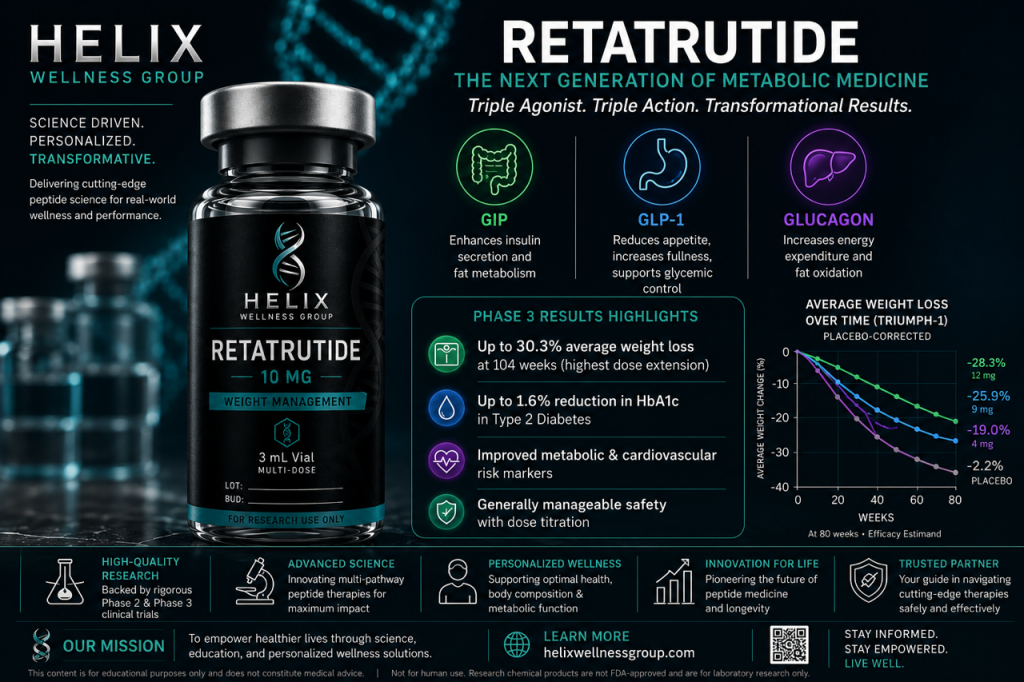
Retatrutide has become one of the most closely watched peptides in modern metabolic research—and the newest Phase 3 findings provide a strong reason for that attention.
Retatrutide is a once-weekly investigational peptide designed to activate three connected hormone receptors:
- GLP-1
- GIP
- Glucagon
Each pathway plays a different role in appetite, glucose control, energy regulation, and stored-fat metabolism.
Rather than relying on appetite suppression alone, retatrutide is designed to coordinate several metabolic signals within one molecule.
Phase 3 results have reached a new level
In the large TRIUMPH-1 clinical trial, adults without diabetes received retatrutide or placebo for 80 weeks.
Participants receiving the highest 12 mg dose lost an average of approximately:
28.3% of their starting body weight
The average participant began near 248 pounds, making the average reduction approximately 70 pounds.
Nearly half of participants at the highest dose lost at least 30% of their starting weight.
A selected group with more severe obesity continued treatment for 104 weeks. In that extension, average weight reduction reached approximately:
30.3%
These are some of the most substantial weight-loss results ever reported in a controlled medication trial.
Retatrutide also worked in type 2 diabetes
People living with type 2 diabetes frequently lose less weight from incretin-based medication than people without diabetes.
Despite that challenge, newly reported Phase 3 results found that the highest-dose retatrutide group lost approximately:
20.8% of starting body weight
Participants also experienced average HbA1c reductions of approximately 1.5% to 1.6%, depending on dose.
This demonstrates that retatrutide’s effects extend beyond the scale to meaningful glucose regulation.
More than weight loss
Researchers also reported improvements in several measurements associated with metabolic and cardiovascular risk, including:
- Waist circumference
- Triglycerides
- Non-HDL cholesterol
- Blood pressure
- High-sensitivity C-reactive protein
- Blood-glucose control
These improvements are highly encouraging.
However, researchers have not yet proven that retatrutide prevents heart attacks, strokes, kidney failure, or cardiovascular death. A dedicated long-term outcomes trial is currently underway to answer those questions.
The highest dose was not automatically the best dose for everyone
The results also revealed an important tradeoff.
Higher doses produced greater average weight loss, but gastrointestinal side effects became more common.
At the highest dose, reported effects included:
- Nausea
- Diarrhea
- Constipation
- Vomiting
- Abnormal skin sensations described as dysesthesia
Approximately 11% of participants receiving 12 mg discontinued treatment because of adverse events, compared with approximately 4% receiving the 4 mg dose.
Interestingly, the lower 4 mg dose still produced approximately 19% average weight loss.
This may become an important part of personalized metabolic treatment: the goal may not always be to reach the highest possible dose. It may be to identify the lowest well-tolerated dose that produces the required result.
Completed findings
Phase 3 human research supports that retatrutide can:
- Produce substantial average weight loss
- Improve HbA1c in type 2 diabetes
- Reduce waist circumference
- Improve several cardiometabolic measurements
- Remain highly effective across different high-risk metabolic populations
- Continue producing weight reduction beyond the first year in many participants
Questions still being studied
Researchers still need to determine:
- Whether retatrutide prevents heart attacks and strokes
- Whether it protects kidney function
- How well weight loss is maintained over several years
- What happens after treatment is discontinued
- How effectively muscle and bone are preserved
- Whether it is superior to tirzepatide in a direct comparison
- Which dose provides the best long-term balance of results and tolerability
The larger scientific opportunity
Retatrutide illustrates where peptide science is heading.
Researchers are moving beyond single-pathway medications and designing molecules capable of coordinating several biological signals simultaneously.
The goal is not simply to reduce appetite. It is to influence:
- Hunger
- Fullness
- Glucose control
- Fat storage
- Energy use
- Liver metabolism
- Obesity-related complications
The current results are extremely promising, but they should be interpreted accurately. Retatrutide has strong Phase 3 evidence for weight reduction and metabolic improvement. Its long-term effects on cardiovascular health, kidney health, physical function, and maintenance remain under active investigation.
Evidence classification: Strong Phase 3 human clinical evidence for weight reduction and glucose improvement. Several newly reported Phase 3 datasets await complete peer-reviewed publication.
Research sources
Phase 2 obesity study — New England Journal of Medicine:
https://www.nejm.org/doi/full/10.1056/NEJMoa2301972
Phase 3 TRIUMPH-1 trial information:
https://clinicaltrials.gov/study/NCT05929066
TRIUMPH-1 Phase 3 results:
https://investor.lilly.com/news-releases/news-release-details/lillys-triple-agonist-retatrutide-delivered-powerful-weight-loss
TRIUMPH-2 and TRIUMPH-3 Phase 3 results:
https://investor.lilly.com/news-releases/news-release-details/lillys-triple-agonist-retatrutide-successful-two-additional
Phase 3 cardiovascular and kidney outcomes trial:
https://clinicaltrials.gov/study/NCT06383390
Head-to-head retatrutide versus tirzepatide trial:
https://clinicaltrials.gov/study/NCT06662383
This article is provided for education. Retatrutide remains investigational, and clinical-trial findings should not be interpreted as individualized medical advice or as a recommendation to use independently sourced research products.