
AUGUST 2, 2026
Another Reason Many Americans Have Lost Confidence in the FDA
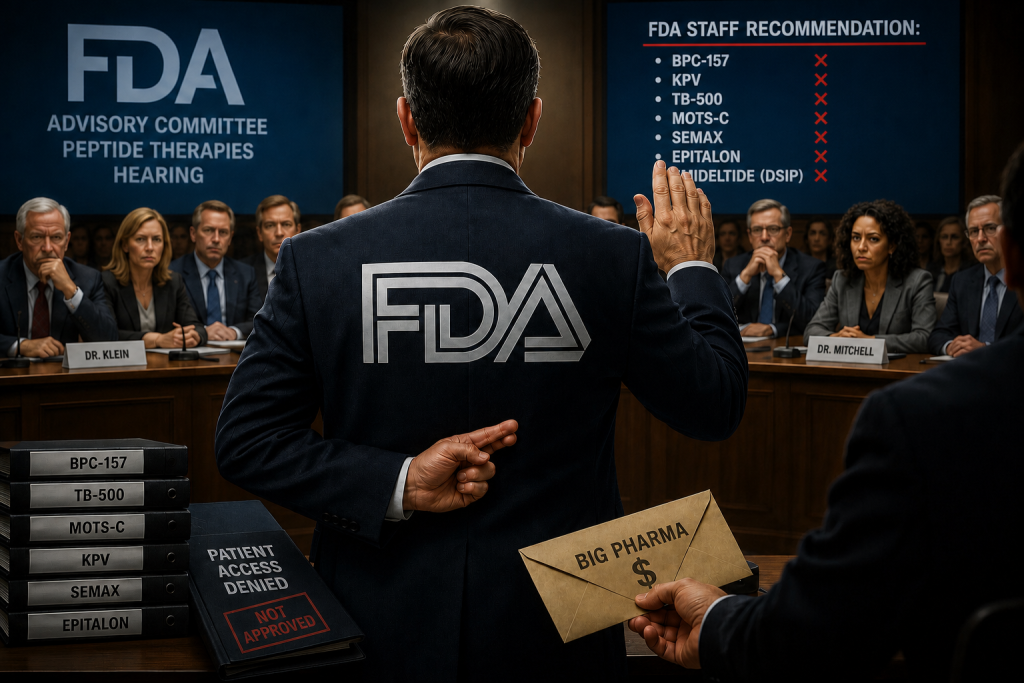
What the FDA’s Peptide Policy Reveals About Evidence, Access, Regulatory Consistency, and Public Health
For years, the Food and Drug Administration has stated that its mission is to protect public health through science-based regulation.
But the recent meeting of the FDA’s Pharmacy Compounding Advisory Committee raised a difficult question:
Is the current regulatory system appropriately balancing scientific uncertainty, patient access, product quality, and the risks created when demand is pushed outside regulated medical channels?
During the July 23–24, 2026 meeting, FDA career staff recommended against adding the reviewed forms of seven peptide compounds to the Section 503A Bulks List.
The external advisory committee ultimately disagreed with FDA staff on six of the seven peptide families:
- BPC-157
- KPV
- TB-500
- MOTS-c
- Semax
- Epitalon
The committee rejected emideltide, also commonly referred to as DSIP.
Because the free-base and acetate forms were voted on separately, the formal proceeding involved 14 substance-specific voting questions. The committee’s favorable recommendations covered both forms of six peptide families. (U.S. Food and Drug Administration)
That result deserves serious examination—but it must also be described accurately.
⸻
What the Committee Vote Did—and Did Not—Mean
The committee did not “approve” these peptides as finished drugs.
It recommended that the FDA consider allowing the nominated bulk drug substances to be used in patient-specific pharmacy compounding under Section 503A of the Federal Food, Drug, and Cosmetic Act.
Section 503A is not the same as the conventional new-drug approval process. When all statutory conditions are satisfied, a qualifying compounded drug may be exempt from:
- New Drug Application approval requirements
- Certain adequate-directions-for-use labeling requirements
- Federal current good manufacturing practice requirements applicable to conventional manufacturers
Compounding pharmacies remain subject to other federal conditions, state pharmacy regulation, professional standards, prescription requirements, and applicable United States Pharmacopeia standards. (U.S. Food and Drug Administration)
The advisory committee’s recommendations are also non-binding. FDA can accept, reject, or modify them, and formal rulemaking may still be required.
Therefore, the vote did not immediately legalize the peptides, authorize broad marketing claims, or establish that they are safe and effective for every use promoted online. (U.S. Food and Drug Administration)
⸻
Seven Peptides—but Only Certain Uses Were Reviewed
Another important distinction is that the FDA did not evaluate every potential use associated with these compounds.
The agency reviewed the substances in the context of specific nominated uses:
- BPC-157: Ulcerative colitis
- KPV: Wound healing and inflammatory conditions
- TB-500: Wound healing
- MOTS-c: Obesity and osteoporosis
- Emideltide/DSIP: Opioid withdrawal, chronic insomnia, and narcolepsy
- Semax: Cerebral ischemia, migraine, and trigeminal neuralgia
- Epitalon: Insomnia
A favorable committee recommendation for inclusion on the 503A Bulks List should not be represented as validation of unrelated claims concerning longevity, athletic performance, generalized recovery, anti-aging, or body composition. (U.S. Food and Drug Administration)
That distinction matters for clinicians, patients, pharmacies, and businesses communicating about these compounds.
⸻
FDA’s Concerns Were Broader Than “Not Enough Clinical Trials”
Much of the public discussion has focused on FDA’s position that the peptides lacked sufficiently large or well-controlled human studies.
That was an important part of the agency’s argument, but it was not the only concern.
FDA’s formal framework considers four general factors:
- Physical and chemical characterization of the substance
- Safety issues associated with use in compounded drugs
- Available evidence of effectiveness or lack of effectiveness
- Historical use in compounding
FDA staff also raised concerns involving:
- Inconsistent naming conventions
- Uncertain differentiation between free-base and acetate forms
- Missing or inconsistent quality information
- Peptide-related impurities
- Incomplete synthesis reactions and truncated sequences
- Aggregation and degradation
- Potential immunogenicity
- Formulation stability
- Sterility, endotoxins, and particulates in injectable preparations
- Differences among oral, injectable, nasal, transdermal, and rectal routes
In its BPC-157 review, for example, FDA stated that the nomination materials contained inconsistent information about whether the nominated substance was BPC-157 free base or BPC-157 acetate. FDA considers those to be different active pharmaceutical ingredients. (U.S. Food and Drug Administration)
These are legitimate pharmaceutical-quality questions.
Acknowledging them does not require accepting FDA’s final conclusion. It simply makes the disagreement more scientifically accurate.
⸻
The Evidence-Transparency Question
One of the most important allegations discussed after the meeting came from Dr. Alex Tatem, who testified regarding all seven peptides.
Dr. Tatem contended that relevant supportive information—including real-world experience—was not adequately represented in FDA’s briefing materials.
FDA’s own introductory document states that its briefing packages may not include every issue relevant to the committee’s final recommendation and are intended to focus on issues the agency selected for discussion. (Hims House)
That statement does not prove that FDA deliberately concealed favorable evidence.
It does, however, raise a legitimate transparency question:
What evidence did FDA receive, what evidence did it include, what evidence did it exclude, and what criteria were used to make those decisions?
When an agency concludes that evidence is insufficient, the public should be able to distinguish among:
- Evidence that does not exist
- Evidence that exists but is methodologically weak
- Evidence that was submitted but deemed unreliable
- Evidence that was not reviewed
- Evidence that was reviewed but not included in public briefing materials
Without that transparency, “insufficient evidence” can become an overly broad conclusion that conceals important differences in the actual evidentiary record.
⸻
The Lone Rejection: Emideltide, or DSIP
The committee did not support every peptide automatically.
Emideltide, commonly referred to as DSIP, failed by a narrow vote of six in favor, seven against, and one abstention.
FDA staff and committee members cited several concerns:
- Inadequate chemical characterization
- Potential peptide-related impurities
- Limited and dated clinical evidence
- Uncertain evidence of effectiveness
- The existence of FDA-approved treatments for insomnia, narcolepsy, and opioid withdrawal
The decision is important because it demonstrates that committee members were willing to distinguish among the substances rather than treating “peptides” as a single category. (RAPS)
It also illustrates what a substance-specific, indication-specific assessment can look like.
⸻
Approval Does Not Eliminate Uncertainty
FDA approval is an important safeguard, but it cannot eliminate every unknown.
History contains multiple examples in which significant safety concerns became clearer only after a medication was used by much larger populations:
- Vioxx was withdrawn after controlled-trial evidence identified an increased risk of serious cardiovascular events.
- Fenfluramine and dexfenfluramine were withdrawn after their association with cardiac valvular disease became apparent.
- Some oncology indications granted accelerated approval have subsequently been withdrawn when confirmatory studies failed to verify the anticipated clinical benefit or when sponsors did not complete the necessary evidence development. (U.S. Food and Drug Administration)
These examples do not establish misconduct by FDA, nor do they prove that compounded peptides are safe.
They demonstrate something more fundamental:
Regulatory decisions are always made under conditions of incomplete information.
The relevant question is therefore not whether uncertainty exists. It is how the agency weighs that uncertainty, how consistently it applies its evidentiary framework, and whether it adequately considers the consequences of both action and inaction.
⸻
Different Regulatory Pathways—But the Same Need for Proportionality
Conventional drug approval and Section 503A compounding are not identical regulatory pathways.
It would therefore be inaccurate to argue that every compounded substance should satisfy precisely the same requirements as an FDA-approved mass-market drug—or that FDA must treat the two pathways identically.
The more defensible question is:
Is FDA applying its Section 503A balancing test proportionately, or is it effectively requiring approval-level evidence before permitting individualized pharmacy compounding?
FDA is entitled to demand reliable substance identification, meaningful quality controls, and a reasonable assessment of safety.
But the agency must also consider:
- The severity of the condition being treated
- The adequacy of existing approved options
- The amount and quality of available human evidence
- Historical clinical experience
- The feasibility of obtaining stronger evidence
- The risks of regulated access
- The risks created by prohibition
- Whether enforceable safeguards could reduce uncertainty without eliminating supervised access
That is where the policy disagreement becomes legitimate.
⸻
Does Restriction Actually Improve Safety?
One of the strongest arguments presented during the meeting was straightforward:
People are already using these peptides.
Restrictions do not necessarily eliminate demand. They may redirect patients toward:
- Anonymous internet suppliers
- Products labeled “for research use only”
- Unverified overseas sources
- Materials with uncertain identity or concentration
- Products without sterility or endotoxin testing
- Sellers operating without prescriptions or professional oversight
The practical public-health comparison is therefore not always:
Compounded peptide versus no peptide use.
In many cases, the real comparison may be:
A prescribed product prepared by a licensed pharmacy under defined quality controls versus an unverified product purchased through an unregulated market.
Several committee members concluded that keeping patient decisions inside a regulated medical and pharmacy system may offer greater protection than forcing the same demand into gray-market channels. (Reuters)
That does not mean every peptide should be compounded without restriction.
It supports considering a controlled pathway involving:
- Verified substance identity
- Qualified and traceable API suppliers
- Independent purity and identity testing
- Sterility and endotoxin testing for injectables
- Stability and storage standards
- Prescription and clinical documentation requirements
- Patient informed consent
- Adverse-event reporting
- Restrictions on unsupported promotional claims
Such safeguards could generate better data while reducing the immediate risks associated with unregulated sourcing.
⸻
A Fair Concern About the Committee Itself
Any credible discussion must also acknowledge concerns about committee composition.
Reuters reported that seven committee participants operated or worked for clinics or businesses involved with peptide treatments. Critics argued that these relationships could create financial or professional bias.
The Department of Health and Human Services responded that committee members underwent the same ethics review and vetting required of other FDA advisory committee participants. (Reuters)
The existence of industry relationships does not automatically invalidate a member’s expertise or vote.
But neither should those relationships be ignored.
Transparency requires disclosure and consideration of potential conflicts on all sides—including relationships with peptide clinics, compounding pharmacies, conventional pharmaceutical manufacturers, advocacy organizations, and other interested institutions.
The committee’s votes were also relatively narrow. The results demonstrate substantial disagreement among qualified participants, not a unanimous scientific conclusion.
⸻
What Happens Next
The advisory committee does not control the final outcome.
FDA may:
- Accept the recommendations
- Reject them
- Modify them
- Request additional evidence
- Distinguish among specific chemical forms
- Establish additional conditions or enforcement policies
- Proceed through formal notice-and-comment rulemaking
Regulatory analyses suggest that ordinary rulemaking can take approximately 12 to 24 months, although interim enforcement discretion or other administrative mechanisms could affect the timeline. (Orrick)
The final outcome may also depend on how FDA defines the substance, permissible formulation, quality expectations, and other practical conditions.
For that reason, the committee vote should not be marketed as final FDA authorization.